
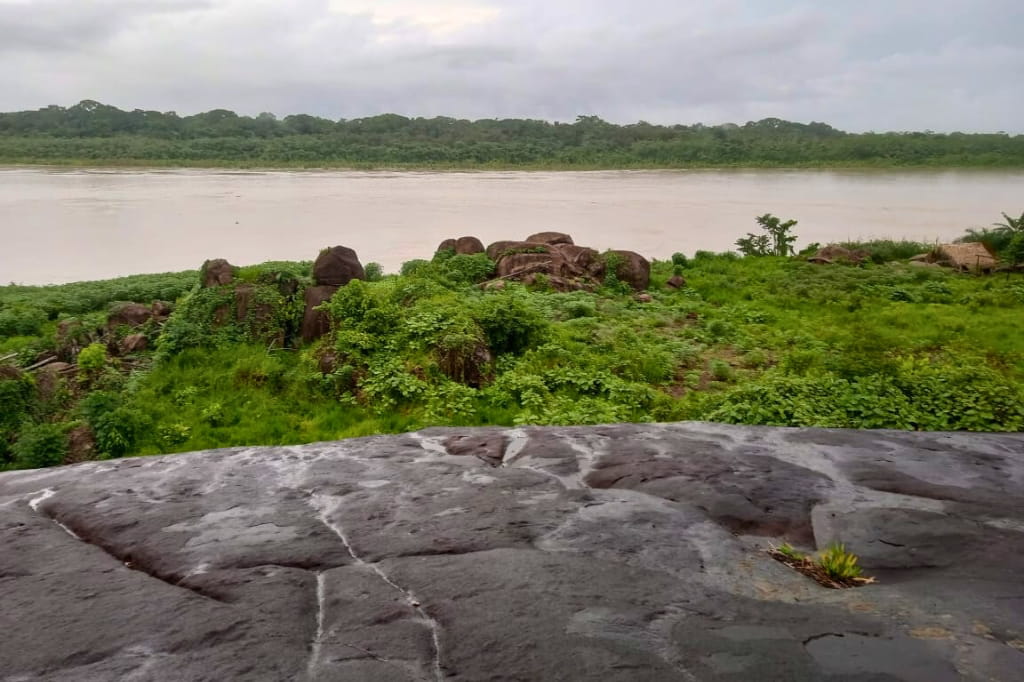
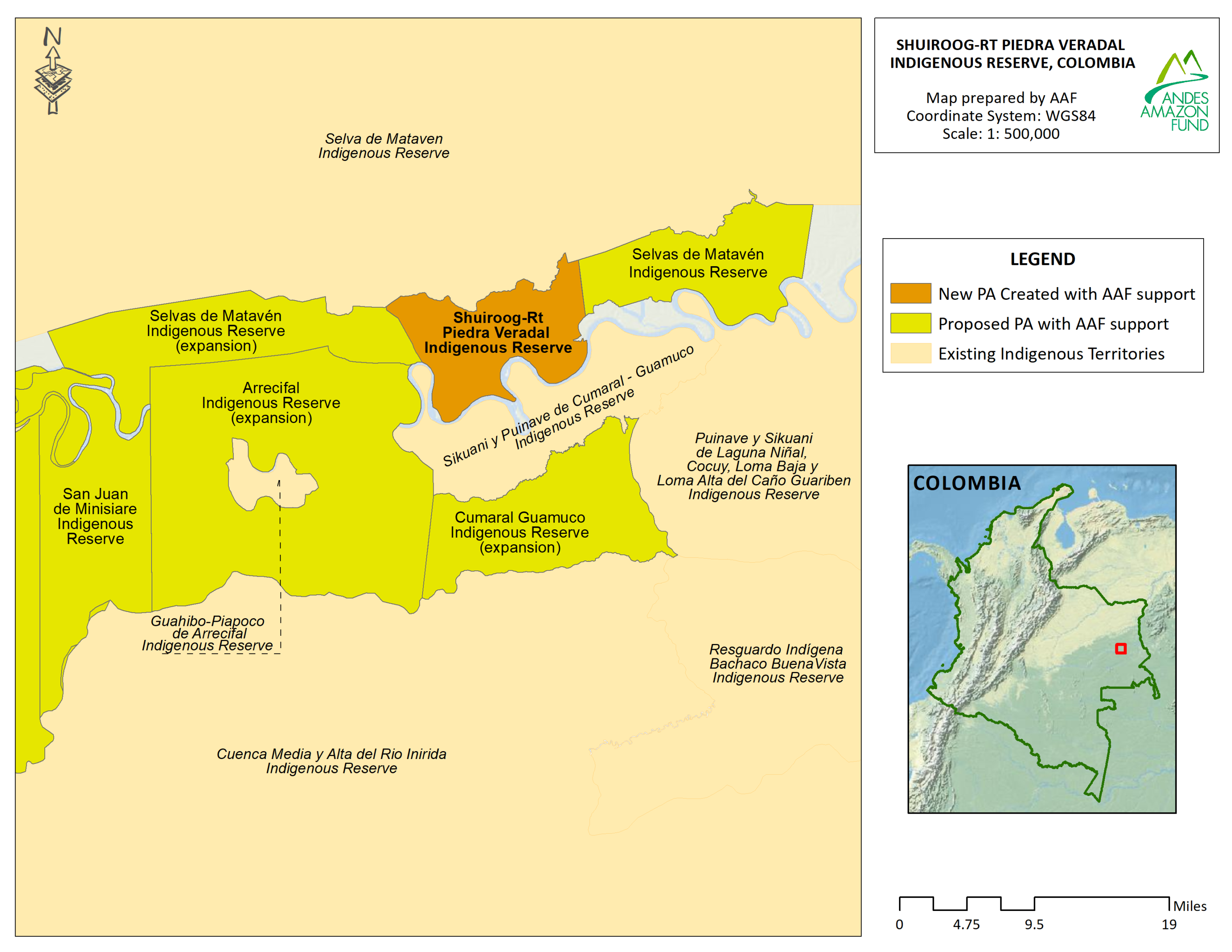
Located in Colombia’s eastern Department of Vichada, the Shuiroog-Rt Piedra Veradal de los Pueblos Piunave y Piapoco Indigenous Reserve spans 51,297 acres (20,759 hectares) and safeguards the biodiverse territory of 31 families of the Puinave and Piapoco Indigenous Peoples. The area spans Orinoquian ecosystems alongside the Guaviare River including subtropical forest, savannahs, and important bodies of water such as the Veradal Lake. The Indigenous Reserve was formalized in December of 2024 and titled on May 27, 2025.
Protecting Orinoquian Ecosystems
The southern limit of the Indigenous Reserve is marked by the Guaviare River which joins with the mighty Orinoco River, about 50 miles east at the Colombia-Venezuela border. The newly titled Indigenous Reserve provides vital ecological connectivity as it is located between the proposed expansion of the Selvas de Matavén Indigenous Reserve and is nearby several other proposed Indigenous reserve expansions supported by AAF which protect important ecosystems alongside the Guaviare River’s path.
Approximately 99.85% of the newly titled territory is designated for conservation by the local Indigenous Peoples in an area covered mostly by wetlands. This new designation increases protection of a territory rich in flooded forest flora species such as palm and legume trees that serve as a sanctuary for diverse fauna in the Amazon-Orinoco transition zone.
Some of the most important wildlife present in the ecosystems of the newly titled Indigenous Reserve include mammals such as the: Colombian red howler monkey (Alouatta seniculus), white-lipped peccary (Tayassu pecari), collared peccary (Pecari tajacu), South American tapir (Tapirus terrestris), armadillo (Dasypus sp.), capybara (Hydrochoerus hydrochaeris), and lowland paca (Agouti paca). Among birds are the: Blue-and-yellow macaw (Ara ararauna), scarlet macaw (Ara macao), red-and-green macaw (Ara chloroptera), guan (Penelope sp.), crestless curassow (Crax tomentosa), black curassow (Crax alector), and nocturnal curassow (Nothocrax urumutum). Among reptiles are the: Yellow-footed tortoise (Geochelone denticulata), green iguana (Iguana iguana), yellow-spotted river turtle (Podocnemis unifilis), and smooth-fronted caiman (Paleosuchus trigonatus). And among fish are the: Brycon (Brycon sp.), tucanare peacock bass (Cichla monoculus), long-whiskered catfish (Pimelodidae), and pacu (Colossoma sp.).
Newly Recognized Puinave and Piapoco Territory
The 31 Puinave and Piapoco families in the Reserve maintain their traditions and culture, including traditional medicinal practices, ecological customs, the Puinave and Piapoco languages, and small-scale subsistence agro-forestry practices through gardens locally known as “conucos”.
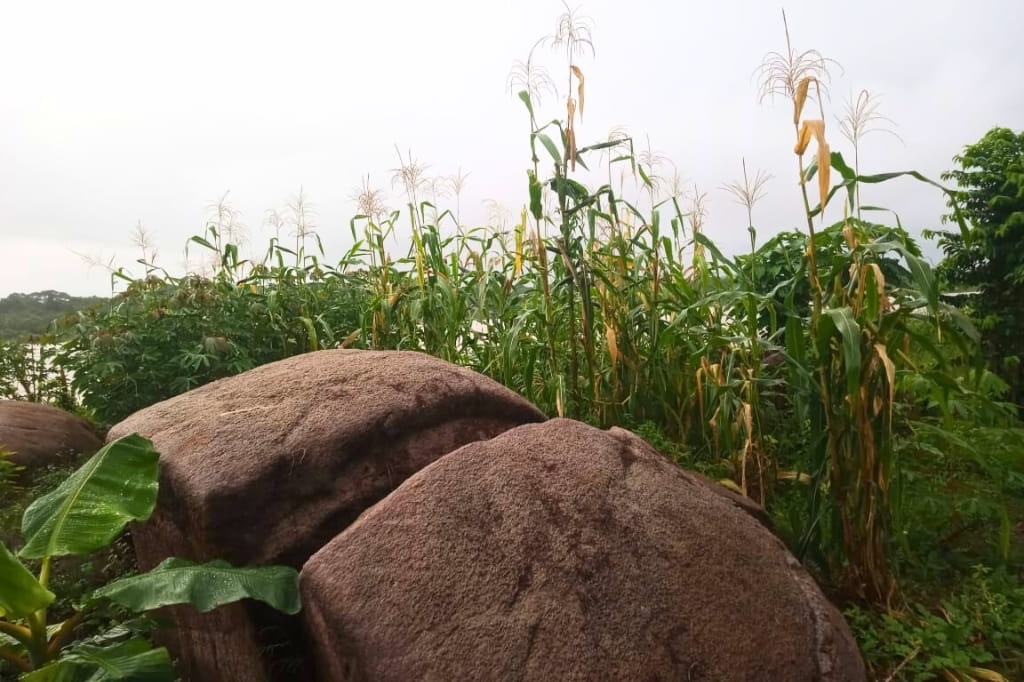
Conucos require no artificial irrigation or heavy maintenance, relying instead on the rainy seasons and natural soil recovery. They yield Yuca, Yam, Pineapple, Nonojí, Chili, and Plantain. As stated in the Indigenous Reserve’s life plan: “Time and nature have taught us how to identify the right places to plant and the precise way to cultivate while conserving nature.”
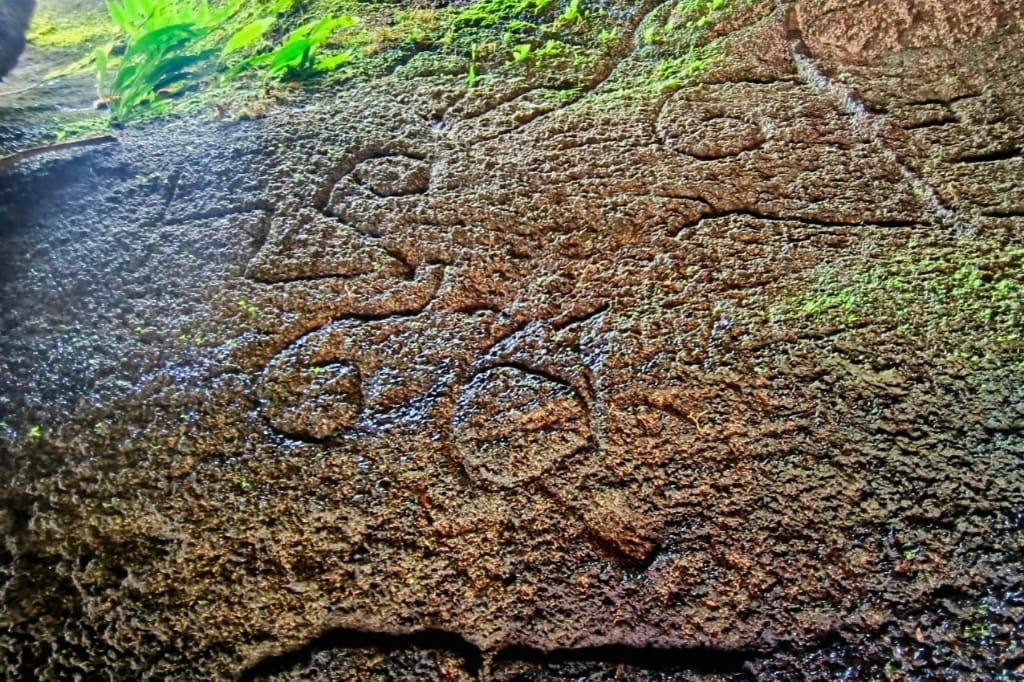
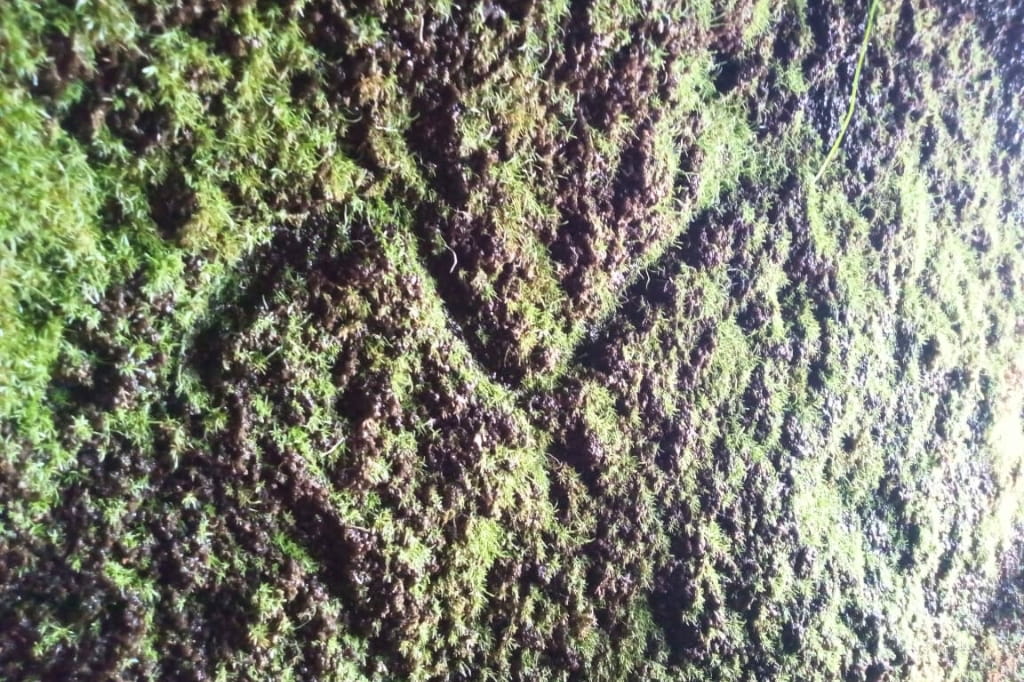
Across the newly titled territory the Puinave and Piapoco communities have identified five specific sacred sites, including the “Guacamayas” and “Veradal” lagoons. The territory also contains evidence of ancient human history with large rocks featuring ancient petroglyphs marking the land as archaeologically significant.
Through the Reserve’s formal recognition, the Indigenous Peoples of the Shuiroog-Rt Piedra Veradal Indigenous Reserve can strengthen their ancestral knowledge and advance governance of their territory, contributing to nature conservation, food security, and the well-being of their communities.
Acknowledgements:
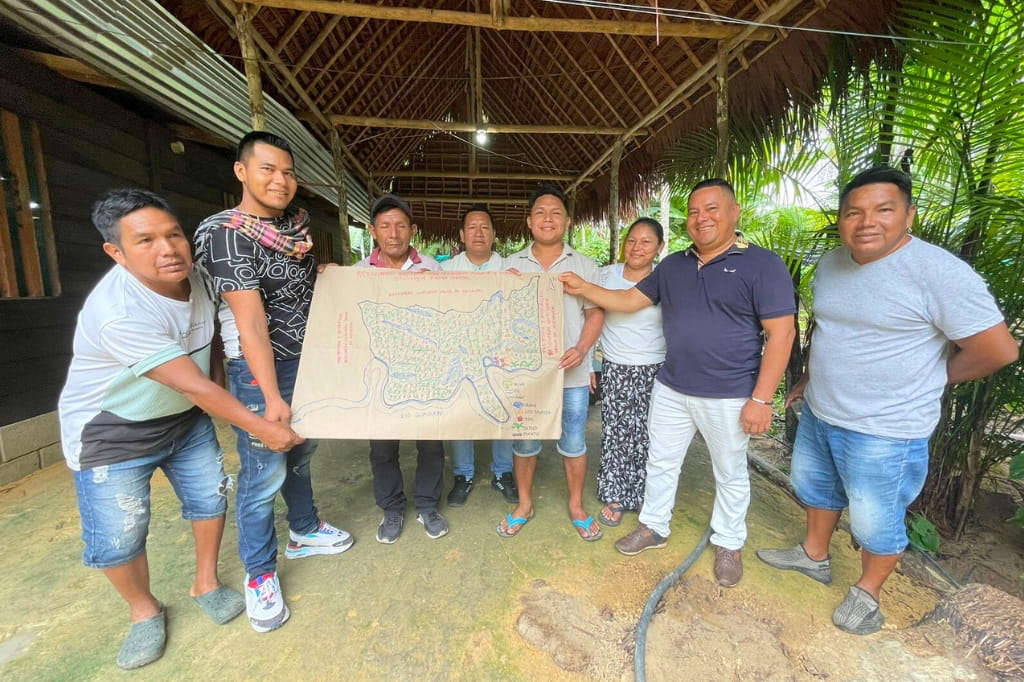
This achievement was made possible by the communities of the Shuiroog-Rt Piedra Veradal de los Pueblos Piunave y Piapoco Indigenous Reserve and Colombia’s National Land Agency with technical support from the Amazon Conservation Team and financial contributions from Andes Amazon Fund, Art into Acres, Re:wild, and Bezos Earth Fund.
MAKE AN IMPACT
Learn how we can make an impact in our world together. Donate or get involved by subscribing to our email list: